
A supernova impersonating a gravitational wave source: ENGRAVE unveils the impostor
The ENGRAVE paper on SN 2025ulz - an object contained within the localization region of the possible gravitational event S250818k - has been published.
On the 18th of August 2025, the international LIGO-Virgo-KAGRA gravitational wave detector network noticed an uncommon signal in the datastream. It was most likely just terrestrial “noise” as the extremely sensitive detectors can be affected by a variety of local environmental disturbances that can induce some spurious signals. Nevertheless, the real-time analysis algorithms estimated a roughly 30% chance that it was an actual astrophysical signal. If that was the case, then it looked like gravitational waves from the merger of a neutron star and a compact object with a mass below that of the Sun. Could it have been an unusually light black hole? Or perhaps an exotic compact object of an entirely unknown kind? These were intriguing possibilities, which tickled the curiosity of many.
The arrival direction of the putative signal could only be constrained to a sky region of about one thousand times the size of the full moon. Even so, astronomers were eager to point their telescopes to look for any new source of light that might be associated with the signal. Among the facilities which started the search, there is one which is particularly well suited to scanning large areas of the sky: the Zwicky Transient Facility (ZTF). ZTF employs a camera with an extremely large field of view mounted at the Palomar Observatory in southern California, US. The search began quickly, and just about twelve hours later, the ZTF team reported an interesting candidate: AT 2025ulz, a newly discovered transient whose nature was still unknown. The candidate was located at a distance compatible with that inferred for the putative gravitational wave signal and it was fading rapidly, a behavior expected from the electromagnetic emission following a compact-object merger. Moreover, images of the same part of the sky taken a few days earlier by the Pan-STARRS facility at Haleakalā Observatory, Hawaiʻi, US, displayed no sign of emission at the position of AT 2025ulz, showing that it was a “young” new transient. Pan-STARRS is another wide-field facility that repeatedly scans the sky and is co-managed by fellow ENGRAVE collaborators.
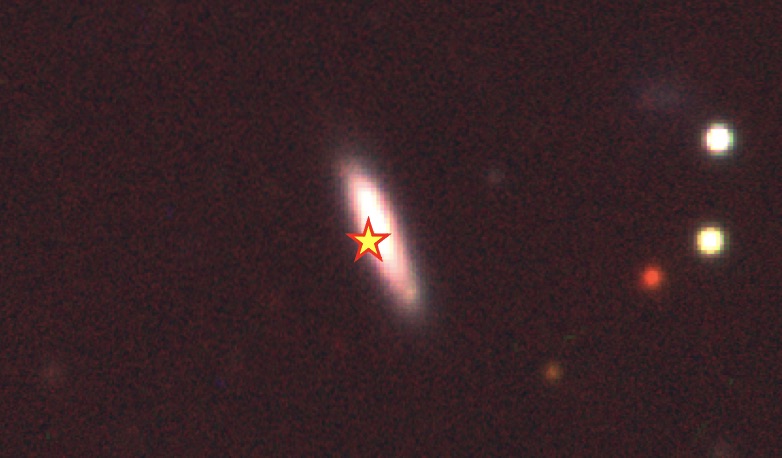
At ENGRAVE we were closely following the situation and, intrigued by this source, we decided to activate our observing programs at the Very Large Telescope (VLT) to shed light on its nature. We obtained optical and near-infrared imaging and spectroscopy of AT 2025ulz with FORS2, HAWK-I and X-shooter, but unfortunately, the source was more challenging than we initially thought. The host galaxy was quite bright at the position of the transient (see Figure 1), and in absence of deep template images and spectra (that is, data taken before the appearance of the transient, showing the galaxy alone) it was not straightforward to disentangle the emission of AT 2025ulz from that of its galaxy.
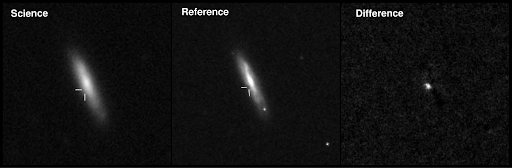
Figure 1: Our HAWK-I near-infrared image of SN 2025ulz and its host galaxy is shown on the left, while the central image was constructed from archival snapshots of the same field (before the SN exploded). Subtracting the two images, we obtained a clear view of the SN 2025ulz light alone (image on the right).
In the next few days, several groups kept observing the source, but no consensus was reached on its nature and its potential connection with the putative gravitational wave signal. Things started to change about one week later, when the source’s light fading trend turned into a re-brightening. Such behavior was not clearly expected from the electromagnetic emission produced by a merger of compact objects, while it is typical of “type IIb” core-collapse supernovae, which are often preceded by a short, rapidly fading “shock cooling tail”. It was during the re-brightening phase that ENGRAVE performed a decisive observation with MUSE, the integral field spectrograph at the VLT. MUSE yields an image of the source and its host galaxy, and a spectrum for each pixel in the image. Thanks to such a detailed dataset, we could better disentangle the spectra of the transient and of the host galaxy: the former showed a good match with spectra of known type IIb supernovae, including the presence of a distinguishing feature - a “P-Cygni” absorption line associated to hydrogen (see Figure 2). Once the nature of the source was unveiled, the name itself of the transient changed from AT 2025ulz to SN 2025ulz, reflecting the supernova origin. We described our observation campaign, our analysis and our interpretation of SN 2025ulz in an article that has been published recently in the journal Astronomy & Astrophysics.
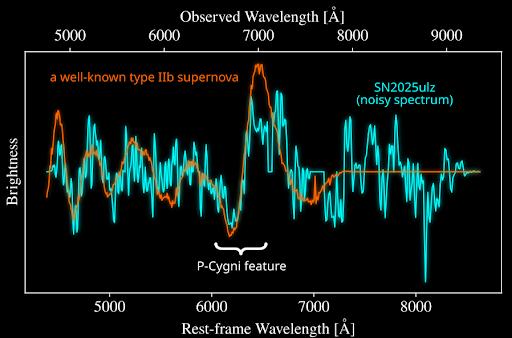
Figure 2: Our spectrum of SN 2025ulz obtained with MUSE is shown in light blue. The wiggles are due to the relatively noisy image, but the overall spectral shape matches well that of a well-known type IIb supernova (shown in orange), especially in the central part where the “P-Cygni” feature, due to Hydrogen, is visible.
But the full story is not finished yet. Although SN 2025ulz resulted to be a supernova, rather than an exotic source or a binary compact object merger, its location within the sky region of the putative GW signal raises new intriguing questions. Could a type IIb supernova be related to the putative gravitational wave signal from the merger of a neutron star with a lighter compact object? This seems unlikely, but some colleagues came up with an interesting scenario where compact objects form and merge within a collapsing star before its explosion. This scenario has been proposed to explain SN 2025ulz, and also two other possible associations of supernovae with gravitational wave signals (SN 2025adtq and SN 2019npv). In our article, we evaluate these claims, and we conclude that these associations are most likely just chance coincidences: supernovae are relatively common, and it is not surprising to find one in a large area of the sky associated with a gravitational wave signal.
Nevertheless, the era of multi-messenger astronomy with gravitational and electromagnetic waves has just started: we are sure that new, surprising and intriguing observations will come soon, and ENGRAVE is ready to contribute to their study.